Archmedis
Freshwater infrastructure,
built offshore.
A modular, passive desalination platform. Solar-driven thermohaline distillation. No coastal land, no grid power, no concentrated brine stream.
The System
A distributed desalination platform. Deployed offshore.
Archmedis is a fleet of floating modules that convert seawater to freshwater using solar heat alone. Each module is self-contained, independently moored, and connects to a shared subsea collection line feeding shore.
Capacity scales by adding modules — not by rebuilding plants. A single failure is isolated to a single unit. The architecture is additive, not monolithic.
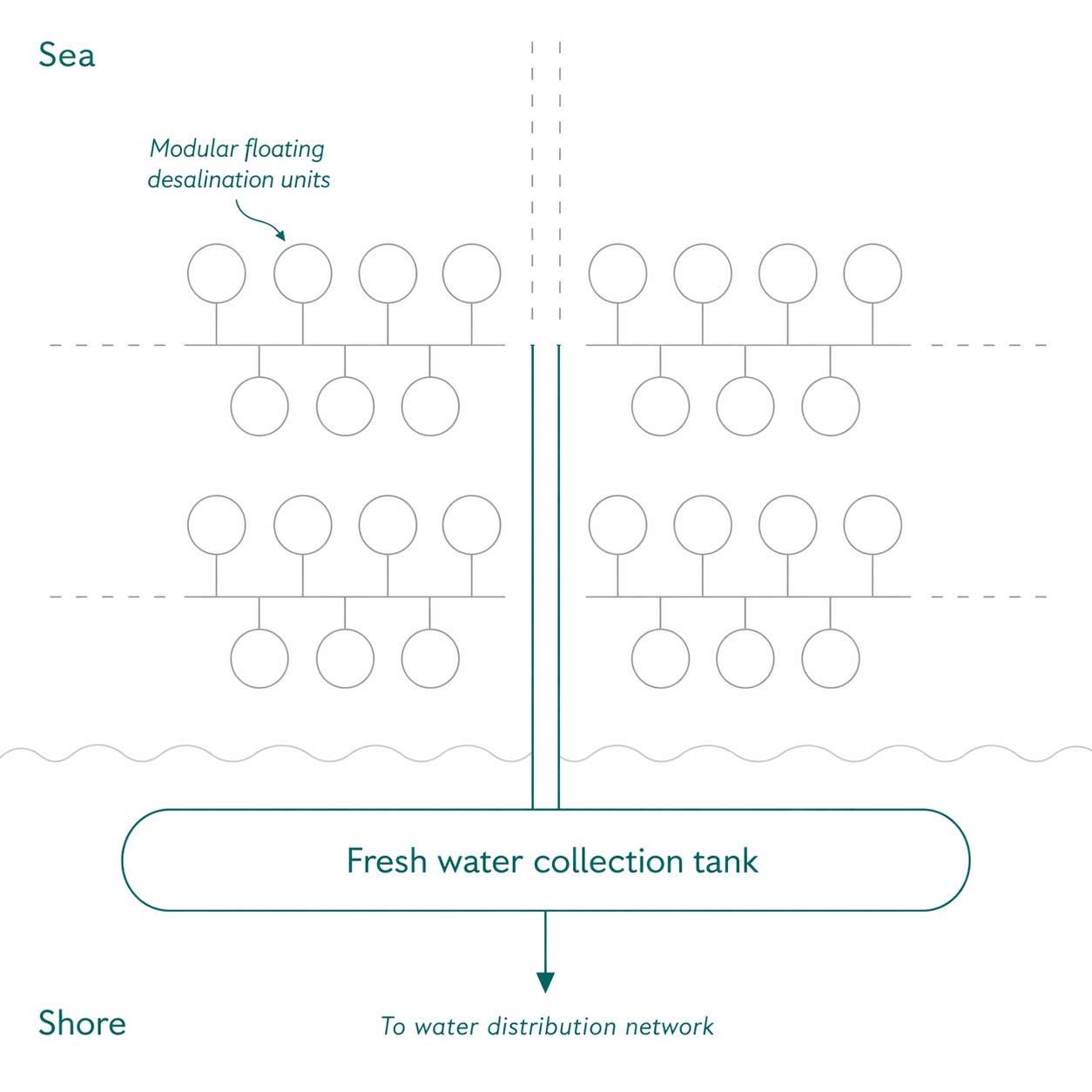
Deployment Configuration
Energy
Solar only.
No grid. No fuel. No combustion in the generation step.
Discharge
No brine stream.
Thermal return to the water column only. No concentrated effluent to manage.
Footprint
Ocean-deployed.
No coastal land. No onshore foundations.
Scale
Additive.
Capacity grows by unit count. No redesign, no re-permitting.
How It Works
Passive thermohaline desalination.
Sunlight heats seawater inside each module, establishing a temperature and salinity gradient. Vapor crosses a phase boundary and condenses as freshwater. The phase change is driven by the gradient itself.
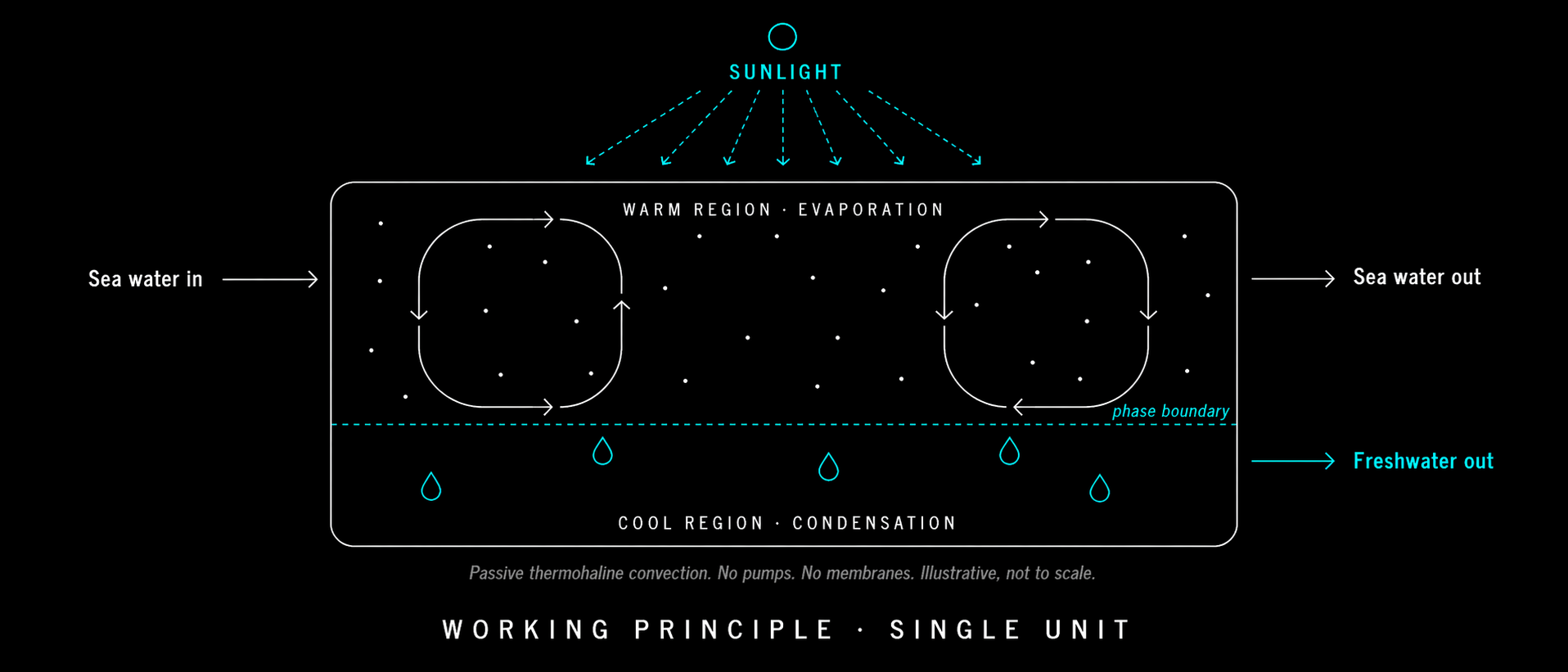
01
Solar input
Sunlight heats the saline region of the module through its optical surface. A phase-change medium retains thermal energy, extending operation past peak irradiance.
02
Thermohaline separation
The gradient drives evaporation and condensation across the phase boundary. No membranes. No applied pressure. No moving parts in the generation step.
03
Freshwater collection
Condensate is drawn off to a shared subsea line. Each module operates independently — a failure in one unit stays contained to that unit.
Infrastructure Context
Centralized water infrastructure is an efficient failure mode.
Most freshwater today is produced by a small number of large plants. The architecture is capital-efficient but structurally fragile. A single disruption — mechanical, environmental, or adversarial — removes supply for millions. Strategic reserves are measured in days.
There is no independent backup layer. Archmedis is building that layer — distributed, passive, and additive.
Centralized → Distributed
Large plants concentrate risk. Independent modules contain it. No single failure disrupts total output.
Carbon-intensive → Solar-driven
Reverse osmosis depends on the grid and its carbon profile. Archmedis runs on sunlight, with no combustion or grid input in the generation step.
Land-based → Ocean-deployed
Coastal land and permitting are scarce. Offshore deployment bypasses both structurally.
No distributed, passive desalination system operates at commercial scale today. Archmedis is building that layer.
Where It Deploys First
Three operational contexts.
Archmedis is built for contexts where distributed water supply is operationally valuable — not only technically feasible. Initial deployments target three buyer profiles.
01
Water Authorities & Governments
A resilience layer against single-point failure in centralized supply. Offshore deployment bypasses coastal land and onshore permitting. Output supplements existing networks under long-term supply agreements.
Discuss a resilience deployment02
Utilities & Infrastructure Operators
Integrates with existing distribution at per-m³ pricing. Capacity grows incrementally — no new large-plant build cycles, no re-permitting. Additive by design.
Request integration brief03
Remote, Offshore & Island Operations
Freshwater production where grid and logistics are the binding constraint. Autonomous operation on solar input. Built for environments where resilience is non-negotiable.
Evaluate for your siteWhere We Are
Pre-pilot. Pre-revenue. Architecturally credible.
We are not claiming field traction we do not have. Our credibility is architectural: standard physics, standard materials, a defined validation pathway.
Patent Filed
Thermohaline module architecture
Core architecture is under active intellectual property protection. Application on file.
Standard Materials
No exotic components
No proprietary materials. No supply-chain dependency. The structural advantage is geometry, not chemistry.
Pilot Scoped
Validation pathway defined
Phase 1 validates performance, durability, and unit economics under Gulf-equivalent conditions. Commercial deployment follows field validation.
Engage
We are selecting early partners.
Archmedis is working with a small number of utilities, authorities, and infrastructure operators on first deployments. If your water supply architecture exposes you to single-point failure, we should talk.
Deployment
For utilities, authorities, and operators evaluating distributed water supply at scale.
Start a deployment conversationEngineering
For technical review, due diligence, and engineering partners assessing the architecture.
Request the technical brief